

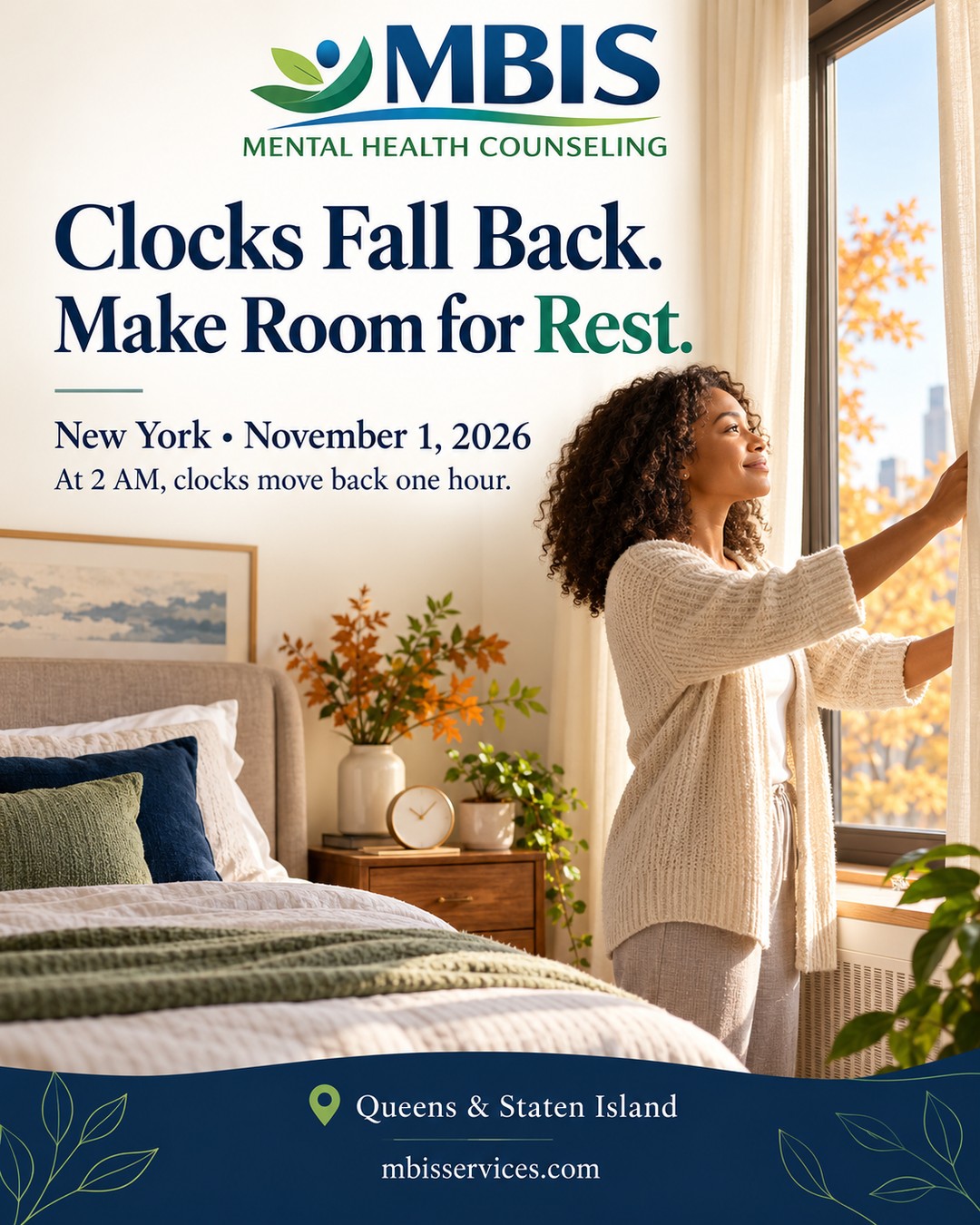
Daylight saving time ends in New York on Sunday, November 1, 2026, at 2 a.m. Clocks move back one hour to 1 a.m. That repeated hour can look like a welcome bonus, but a clock change does not automatically create a restful night. Work schedules, caregiving, late-night plans and an already busy mind still shape how you sleep.
If you live in Queens, Staten Island or elsewhere in New York City, this is a useful moment to check your routine before the weekend. The aim is not perfect sleep on command. It is a practical plan that protects time for rest and helps you notice when a concern deserves professional attention.
Quick answer: When daylight saving time ends, confirm your clocks and commitments, protect adequate sleep time, use a manageable daily schedule, make room for daylight and activity, reduce evening stimulation, plan household responsibilities, and seek help for persistent sleep or mood concerns.
Published October 29, 2026. Educational information from MBIS Counseling Services. This guide is for adults and does not replace individualized medical or mental health care.
When does daylight saving time end in 2026?
NYC311 confirms November 1, 2026, at 2 a.m. as the end of daylight saving time. A clock that is adjusted manually goes back to 1 a.m. Many connected devices update automatically, but checking their settings ahead of time can prevent confusion.
The National Institute of Standards and Technology explains that the fall change repeats an hour. It also shifts daylight toward the morning by clock time. It does not add sunlight to the day; seasonal daylight continues to change independently.
For New Yorkers coordinating with people in other states or countries, confirm the actual local time rather than assuming everyone changes clocks together. A recurring online appointment or family call deserves a quick check, especially if another location follows a different seasonal schedule.
How is fall back different from spring forward?
In spring, the clock skips an hour. In fall, an hour repeats. These are different changes, so research headlines about losing sleep during the spring transition should not be treated as predictions about your November weekend.
You might welcome the extra hour, feel sleepy earlier by the new clock, or notice little difference. An occasional unsettled night does not establish a sleep disorder. Look at your overall pattern and how you function during the day rather than judging your health by one morning.
Sleep and emotional well-being are connected. The HHS guide to getting enough sleep notes that adequate sleep supports mood, thinking and everyday functioning. Most adults need at least seven hours, though individual needs vary. The following steps combine basic sleep guidance with practical planning examples for a busy household.
7 helpful routine tips when daylight saving time ends
1. Check the clock and the commitments around it
Choose a brief moment before Sunday to review devices that may need manual adjustment. Think beyond the clock on the wall: a kitchen timer, a car display, an older alarm or a workplace schedule may not match your phone automatically.
Then review the next morning. What time is your shift, transportation, childcare handoff or appointment? Put essential details in one place so that you are not trying to resolve several conflicting clocks while tired.
If you work during the repeated hour, ask your workplace how it records schedules and handoffs. For time-sensitive medication instructions, contact your prescriber or pharmacist about the clock change rather than independently changing dose timing. A calendar reminder can help you remember to ask before the weekend.
2. Protect time for sleep instead of filling the extra hour
The return to standard time can become an excuse to add another task or stay out later. Before making that choice, consider whether your week has already left you short on rest. A clock adjustment cannot erase an ongoing pattern of too little sleep.
Identify one task that can wait. Perhaps the laundry can be finished tomorrow, a nonurgent message can be answered after breakfast, or a late gathering can end earlier. Protecting rest often starts with a decision about your calendar rather than a new bedtime product.
For example, someone with an early Sunday shift might prepare clothing and transportation plans on Saturday afternoon. This does not guarantee better sleep, but it removes a few decisions from the end of the day and makes the intended rest period easier to protect.
3. Build a realistic schedule you can repeat
The NHLBI healthy sleep guidance recommends consistent bed and wake times. Choose a routine that fits your real responsibilities rather than an ideal schedule you can maintain for only one night.
Write down when you need to be awake, what preparation the morning requires and when your evening responsibilities normally end. If the plan leaves too little time for sleep, the problem may be the workload itself. Consider what can be shared, simplified or rescheduled.
Night workers and people with rotating shifts may need a different approach from those working daytime hours. Ask a healthcare professional about persistent difficulty adapting to your schedule. Do not force a daytime-worker plan onto a pattern of overnight work, or change an existing clinician-directed sleep plan without discussing it.
4. Make room for daylight and comfortable activity
Light is one of the cues involved in the body’s daily timing system. General sleep guidance encourages outdoor time when possible and regular physical activity. The clock change can be a reminder to plan an accessible opportunity rather than waiting for a completely free afternoon.
In Queens or Staten Island, that might mean a short outdoor break during the day, a walk with a friend, or time in a nearby outdoor space that fits your mobility, weather and safety needs. Choose something you can repeat without turning it into another demanding obligation.
More light at a particular hour is not a universal treatment for every sleep pattern. If you have persistent very early waking, a diagnosed circadian condition, or questions about light therapy, ask a qualified clinician about timing. This guide does not prescribe a light box or a personalized light-exposure schedule.
5. Create a quieter transition into the evening
Consider what the last part of your evening currently contains. Work messages, upsetting news or an intense family discussion may continue long after you intended to wind down. Choose one small boundary that makes the transition easier to recognize.
For example: put tomorrow’s nonurgent tasks on a list, choose a stopping point for email, and switch to a calmer activity. Basic sleep guidance also supports a quiet, dark, comfortable sleep environment and reducing bright screen exposure near bedtime.
Review caffeine and alcohol habits with sleep in mind. Alcohol is not a dependable sleep solution, and caffeine later in your day can interfere with sleep. If you are unsure how medicines, supplements or substances affect your rest, discuss them with your healthcare provider. Our digital overload guide offers related ideas for setting limits around notifications.
6. Plan for the household, not just your own alarm
Daylight saving time ends for the whole household, but responsibilities may not be shared equally. A parent, caregiver or overnight worker may have little control over interruptions. A useful plan names the support needed rather than assuming everyone can simply sleep longer.
Discuss who will handle early tasks, transportation or a care handoff. If another person depends on supervision, arrange appropriate coverage before changing the routine. You might ask, “Can you handle breakfast while I finish my rest period?” or “Can we review Sunday’s handoff time together?”
These examples are planning prompts, not instructions to delay a dependent person’s needs. For ongoing caregiving strain, our caregiver burnout guide explores asking for practical help. Small adjustments are more useful when they respect the people and responsibilities already in your life.
7. Notice the pattern and ask for help when needed
If a few nights feel different, record a simple overview of bedtime, waking, daytime sleepiness and anything you want to discuss with a clinician. Avoid repeatedly checking the clock or turning the notes into a score you must improve every morning.
Persistent difficulty falling or staying asleep, continuing daytime exhaustion, or loud snoring and breathing pauses warrant a medical conversation. Do not assume every symptom comes from the clocks. If you feel too sleepy to drive or perform a safety-critical task, pause and arrange a safer alternative.
If worry about sleep or another concern is affecting your daily life, ask about professional support. NHLBI describes cognitive behavioral therapy for insomnia, or CBT-I, as a usual first treatment option for long-term insomnia. Read our CBT-I overview, and confirm the appropriate clinician and current treatment availability rather than attempting a sleep-restriction program on your own.
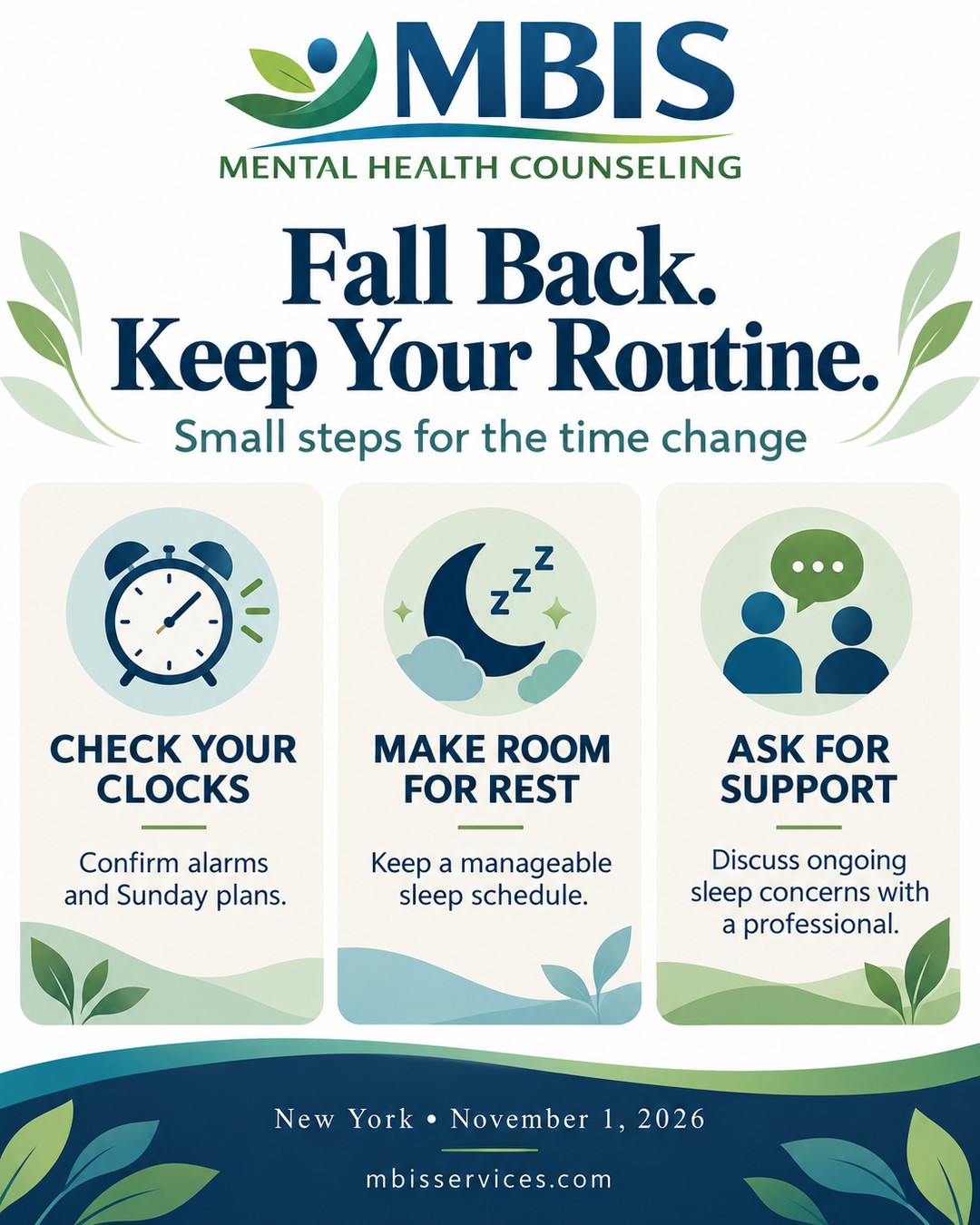
A simple weekend checklist before daylight saving time ends
Keep the plan short enough to use. You do not need to complete every possible sleep improvement before daylight saving time ends.
- Before Sunday: check automatic clock settings, manual devices and next-day commitments.
- Before the evening gets busy: prepare one essential morning task and decide which nonurgent task can wait.
- On Sunday: confirm the new local time, follow a manageable routine and review any household handoffs.
- During the following week: notice how you feel and discuss ongoing concerns with a qualified professional.
If a routine does not work, adjust the plan without treating it as a personal failure. The useful question is “What support or change would make this more realistic?” A household with shift work, caregiving or limited space may need practical cooperation as much as a reminder about bedtime.
Sleep and mental health support in Queens and Staten Island
MBIS Counseling Services provides behavioral health and counseling services. Contact the team to discuss concerns such as stress, anxiety or mood changes and ask which services and clinicians may be appropriate. A primary care provider or sleep specialist can also assess medical sleep concerns.
MBIS has offices at 119-29 80th Road, Suite A, Kew Gardens, NY 11415, and 1110 South Avenue, Suites 63 & 65, Staten Island, NY 10314. Call (332) 222-0711 or visit the contact page to ask about appointment options, service fit, fees and current availability.
If mood changes recur as the seasons change, our seasonal depression article offers a separate introduction. A clock change and seasonal depression are not the same thing, and a clinician can help explore your individual experience.
Frequently asked questions about daylight saving time and sleep
Do clocks go forward or backward in November 2026?
In New York, clocks go backward one hour on November 1 at 2 a.m., becoming 1 a.m. Connected devices may adjust automatically. Check manual clocks and important schedules.
Does falling back guarantee an extra hour of sleep?
No. The clock repeats an hour, but how much you sleep depends on your actual schedule and sleep pattern. Protecting enough time for rest still matters.
Should I start melatonin for the time change?
Do not assume you need a supplement because the clocks change. Talk with your healthcare provider before starting sleep aids or changing a treatment plan; the appropriate approach depends on your situation.
When should I get professional help for sleep problems?
Ask for help when concerns persist, interfere with daytime functioning, or include symptoms such as breathing pauses or significant sleepiness. Seek urgent assistance for an immediate safety concern rather than waiting for a routine counseling appointment.
Sources and further reading
Clock-change details: NYC311 and NIST daylight saving time rules. General sleep guidance: NHLBI healthy sleep habits, HHS Get Enough Sleep and NHLBI insomnia treatment. Household scenarios and scripts are illustrative examples, not accounts of MBIS clients.