

Emotional abuse does not have to leave a bruise to deserve attention. Repeated humiliation, intimidation, isolation, or control can make a relationship feel frightening and confusing. You may care deeply about someone and still feel unsafe around them. You can seek support without first deciding which label describes your experience.
During Domestic Violence Awareness Month in October, MBIS Counseling Services is sharing information about recognizing concerning patterns and exploring support. This guide focuses on intimate relationships and includes resources for people in Queens, Staten Island, and elsewhere in the United States.
Safety and privacy first: If someone monitors your device, browsing or contacting a service may leave traces. Consider using a safer device or speaking with a domestic violence advocate about digital safety. Private browsing does not guarantee privacy. If you are in immediate danger, call 911 when it is safe to do so. This article is educational and cannot assess your individual risk.

What is emotional abuse?
The National Domestic Violence Hotline describes emotional abuse as nonphysical behavior used to control, isolate, or frighten a partner. It can involve insults, threats, manipulation, constant monitoring, and intimidation. An absence of physical injuries does not make these behaviors harmless.
It can be difficult to name what is happening when hurtful experiences alternate with affection, apologies, or ordinary moments. Rather than trying to prove that an entire relationship is “bad,” it may be more useful to describe particular behaviors to a trained advocate. You do not need a perfect explanation, a recording, or someone else’s agreement before asking questions.
Ordinary disagreements and abuse should not be treated as the same thing. Conflict can occur in a relationship where both people retain choice and dignity. A pattern of fear, punishment, and control raises different concerns. The examples below are starting points for discussion, not a test that diagnoses a partner or determines legal outcomes.
| Area | A useful question |
|---|---|
| Disagreement | Can I express a different opinion without fearing punishment? |
| Connection | Can I maintain contact with people I trust? |
| Choice | Can I make ordinary decisions without threats or intimidation? |
| Privacy | Am I pressured to give up access to my messages or accounts? |
7 warning signs of emotional abuse worth discussing
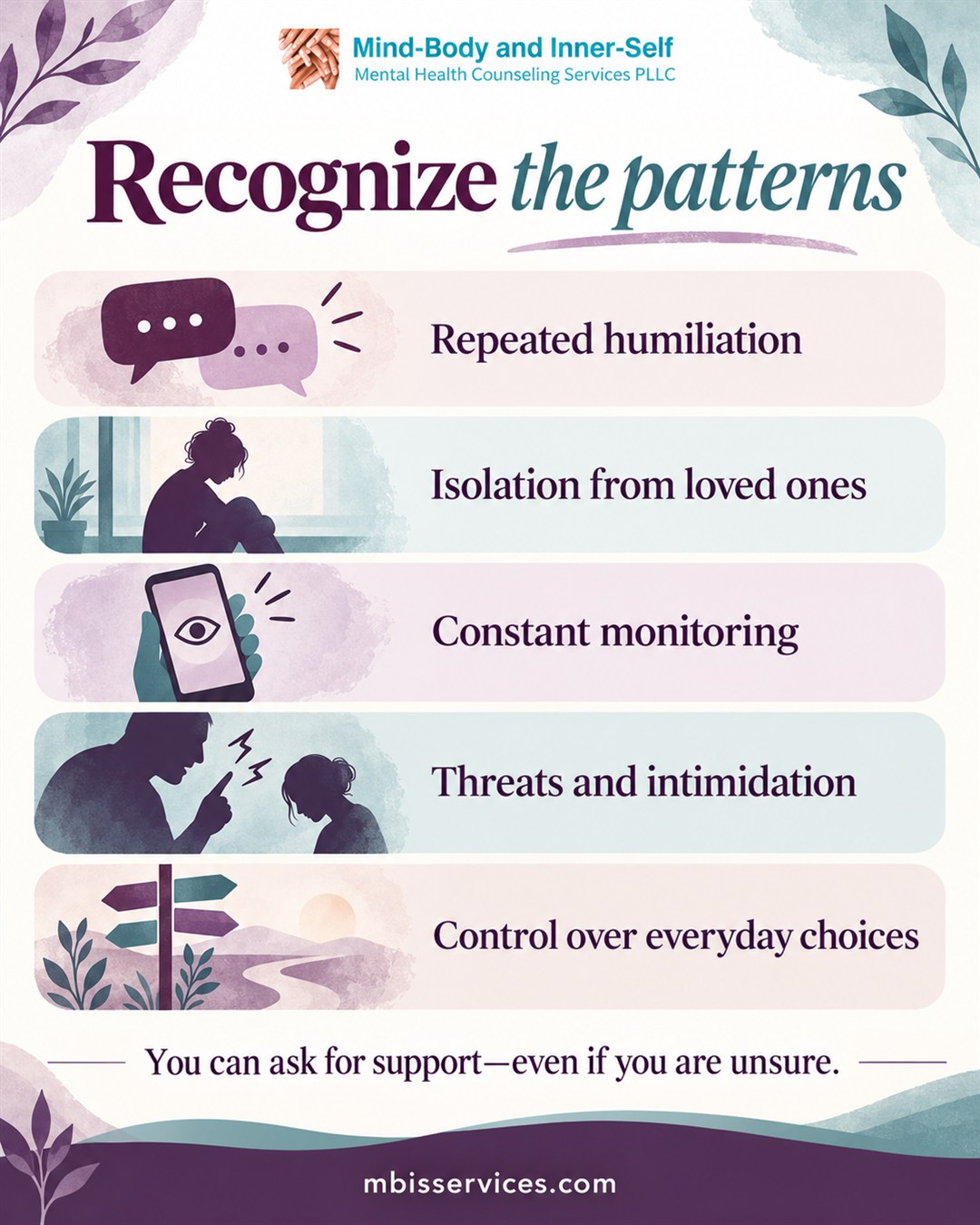
The U.S. Office on Women’s Health identifies emotional and verbal abuse as including attempts to scare, isolate, or control someone. Its guidance describes behaviors such as humiliation, demands for passwords, interference with work or health care, and threats. Any individual situation requires context; this list is not a checklist you must complete to qualify for help.
1. Repeated humiliation or degrading comments
A partner may repeatedly insult you, ridicule your abilities, or embarrass you in front of others. Calling something a joke does not erase the effect of repeated degradation. Consider describing the behavior itself when speaking with an advocate: what was said, what happened afterward, and whether you felt able to object.
2. Isolation from people you trust
Discouraging or preventing contact with family and friends can reduce access to support. This might be framed as loyalty or concern while leaving you with fewer independent relationships. A trusted connection should not require you to defend every conversation. If reconnecting could increase danger, discuss a safer approach with an advocate first.
3. Monitoring presented as proof of love
Constant checking, demands for passwords, and pressure to account for your whereabouts can become controlling. Sharing information freely is different from feeling compelled to share it because refusal may bring retaliation. Before changing passwords, location settings, or a shared account, consider whether the change could be noticed and discuss digital safety with specialist support.
4. Threats and intimidation
Threatening to harm you, someone you care about, or a pet is serious. A person may also use threats involving authorities or other consequences to pressure you. You do not need to wait for a threat to become physical harm before seeking help. Immediate danger requires urgent assistance, rather than a routine counseling inquiry.
5. Control over ordinary choices
Emotional abuse can overlap with control over money, clothing, work, education, or medical appointments. The question is not whether partners ever discuss decisions together; it is whether one person uses fear or coercion to take away the other’s choice. Tell a support professional which restrictions are affecting your daily life.
6. Persistent denial that leaves you doubting yourself
The Office on Women’s Health explains gaslighting as behavior that makes someone question their memory or perception. Repeated denial or reinterpretation of events may be used to maintain control. You do not have to win an argument about a label to take your concerns seriously or to describe them privately to a professional.
7. Blaming you for abusive behavior
A partner may insist that your actions caused their insults, threats, or intimidation. The Office on Women’s Health emphasizes that being abused is not your fault. A conversation about healthy accountability does not make you responsible for another person’s abusive choices. Your need for safety does not depend on being a perfect partner.
How to explore support for emotional abuse safely
If some of these examples feel familiar, a first step can be a private conversation with a trained domestic violence advocate. You may begin with, “I am unsure whether this is abuse, but I would like to discuss what is happening.” You do not need to arrive with a decision about the future of the relationship.
A useful conversation can focus on the concerns that matter most to you. That might be access to a phone, worries about children, a fear of being overheard, transportation, or uncertainty about a safe time to call. Explain what would make a proposed step difficult. Support should account for your circumstances rather than assume that every option is available.
Use an individualized safety plan
The Hotline explains safety planning as a personalized, practical process for improving safety while experiencing abuse, preparing to leave, or after leaving. Planning can include trusted contacts, emotional support, and resources suited to your situation. It is not simply an instruction to leave immediately.
A general article cannot know which actions might increase your risk. Avoid treating confronting a partner, announcing plans, gathering evidence, or suddenly changing shared technology as universally safe steps. A trained advocate can help you weigh options. If you keep notes or save resource information, consider who can access them and whether storing them is safe.
Contact specialist help when you can do so safely
In the United States, the National Domestic Violence Hotline offers support by phone, text, and online chat. Call 1-800-799-7233, text START to 88788, or visit its website to connect with an advocate. Choose a method and device that are safer for your situation. Phone bills, notifications, shared accounts, and browsing traces may matter.
You can ask the service what to expect, what information it needs, and what choices you have. If a call must be brief, you can say that at the start. If one contact option is not workable, that does not mean you have exhausted every route to support. In immediate danger, call 911 when safe.
Distinguish counseling from domestic violence advocacy
Individual counseling may be part of your support network, while domestic violence advocacy addresses specialist needs such as safety planning and connections to relevant resources. Ask each service what it provides and where referrals may be needed. A routine therapy appointment should not be represented as emergency protection, shelter access, or legal representation.
The Hotline does not recommend couples counseling in abusive relationships, explaining that joint sessions can create risks for the person experiencing abuse. If coercion or fear is present, discuss it privately with an appropriately qualified professional rather than assuming that improved communication together is the answer.
How to support someone who may be experiencing emotional abuse
A friend does not have to investigate or decide what the person should do. You can offer a calm opening: “I care about you. Is it safe for us to talk?” Let the person describe what they wish to share. Ask before offering advice or sending links, since messages may be visible to someone else.
The Hotline’s guidance on supporting and intervening emphasizes respecting the person’s choices while expressing concern and offering resources. Pressure can make a conversation feel less supportive. Avoid confronting the abusive person or taking over the survivor’s decisions.
- Try: “I believe you, and you do not deserve to be treated that way.”
- Ask: “What would feel useful and safe right now?”
- Offer: “Would you like help exploring support options?”
- Respect: A request to pause, decline advice, or use a different way of communicating.
Avoid asking why the person has not left or suggesting that they caused the situation. You may not know the barriers involved. If you offer practical help, be clear about what you can reliably provide. A specific offer made with permission is more useful than a promise you cannot keep.

Finding support in Queens and Staten Island
MBIS Counseling Services lists domestic abuse, domestic violence, anxiety, stress, and trauma-related concerns among its behavioral health and counseling service areas. Contact the team to ask about individual support, current availability, and whether its services fit your needs. Specialist domestic violence resources may also be needed.
- Queens: 119-29 80th Road, STE A, Kew Gardens, NY 11415. Call (332) 222-0711.
- Staten Island: 1110 South Ave, STE 63 & 65, Staten Island, NY 10314. Call (332) 222-0711.
Before contacting any practice, consider which communication method is safe. You can ask whether voicemail, text, or email will be used and explain if particular contact methods are unsafe. Ask about confidentiality and its limits, fees, insurance, and provider experience with relationship abuse. Do not assume a general website form is an emergency or anonymous service.
New Yorkers can also explore the city’s Family Justice Center information to learn about specialist local resources. Confirm current access arrangements directly. For a broader discussion of reaching out, read MBIS’s guide to seeking mental health support.
You can start with one question. If it is safe to do so, contact MBIS about counseling or reach a domestic violence advocate for specialist support. You deserve to have your concerns taken seriously, even when you are unsure what comes next.
Frequently asked questions about emotional abuse
Can abuse happen without physical violence?
Yes. Emotional abuse can involve nonphysical control, intimidation, humiliation, or isolation. Physical injury is not a requirement for seeking support.
Do I have to be certain before contacting an advocate?
No. You can describe your concerns and ask questions without deciding on a label or making an immediate decision about the relationship.
Should I confront my partner with this article?
Do not assume confrontation is safe. If you are concerned about retaliation, discuss your situation privately with a trained advocate before deciding what to share.
Is private browsing enough to keep resource searches hidden?
No. Internet activity can be monitored, and private browsing does not remove every trace. Consider a safer device and ask an advocate about your specific digital safety concerns.
Is MBIS an emergency domestic violence service?
This article does not establish that MBIS provides emergency protection, shelter, or legal services. Contact specialist domestic violence resources for those needs. Call 911 for immediate danger when safe.
Updated October 18, 2026. Educational information, not an individual clinical assessment, legal opinion, or personalized safety plan. Images are AI-generated illustrations with fictional people and settings; they do not depict actual MBIS staff or patients.